Monday Start vs Sunday Start Digital Planner in Goodnotes: Which Weekly Layout Feels Better to Use?
Compare Monday start vs Sunday start digital planners for Goodnotes, including workweek flow, family routines, school schedules, habit tracking, and weekly review fit.
Photo by Mikhail Nilov on Pexels.
Choosing Monday start or Sunday start is not a tiny cosmetic decision. It changes how your week reads, where your reset naturally happens, and whether the planner feels intuitive every time you open it.
Still comparing layouts?
Build a weekly page around your actual routine
The Weekly Planner Maker helps you test a structure that fits your schedule before you commit to a longer planner workflow.
Open Weekly Planner MakerWhy this small layout choice has a big effect
At first glance, Monday start versus Sunday start looks like a minor preference. But in real use, it changes how the whole week feels. It affects where your eye lands, how your reset maps onto the page, and whether weekends feel like an add-on or a full part of the week. For people who use a planner every day, these small reading differences matter. They influence comfort, speed, and whether the planner feels aligned with the way your brain already organizes time.
That is why buyers keep searching for terms like Monday start planner Goodnotes, Sunday start digital planner, and which weekly layout should I choose. They have often used one format before without thinking much about it, then realized another format might fit their life better. This is exactly the kind of topic where helpful content can remove buying hesitation quickly. The user is not asking for abstract philosophy. They want a simple decision they will not regret once the planner is open.
Who usually prefers Monday-start planners
Monday-start planners usually feel best for people who mentally separate the workweek from the weekend. Professionals, students, and project-driven users often like Monday start because it places the active work block first. The weekly spread begins where most action happens. Saturday and Sunday then sit at the end as either lighter planning space or a natural close to the week.
This can make weekly reviews feel more intuitive if they happen on Sunday evening or Monday morning. The page reads like a fresh start. It also works well for users who plan around classes, meetings, or recurring weekday routines. In these cases, Monday start can create a cleaner visual rhythm because the five busiest days stay grouped together. For many users, that one grouping choice makes the planner feel more ordered immediately.
- arrow_right_altOften best for work-focused, study-focused, or project-based weeks.
- arrow_right_altFeels natural if you reset on Sunday evening and begin the new week on Monday.
- arrow_right_altGroups busy weekdays together for cleaner scanning and prioritization.
Product spotlight
A planner that lets you choose the weekly flow that feels right
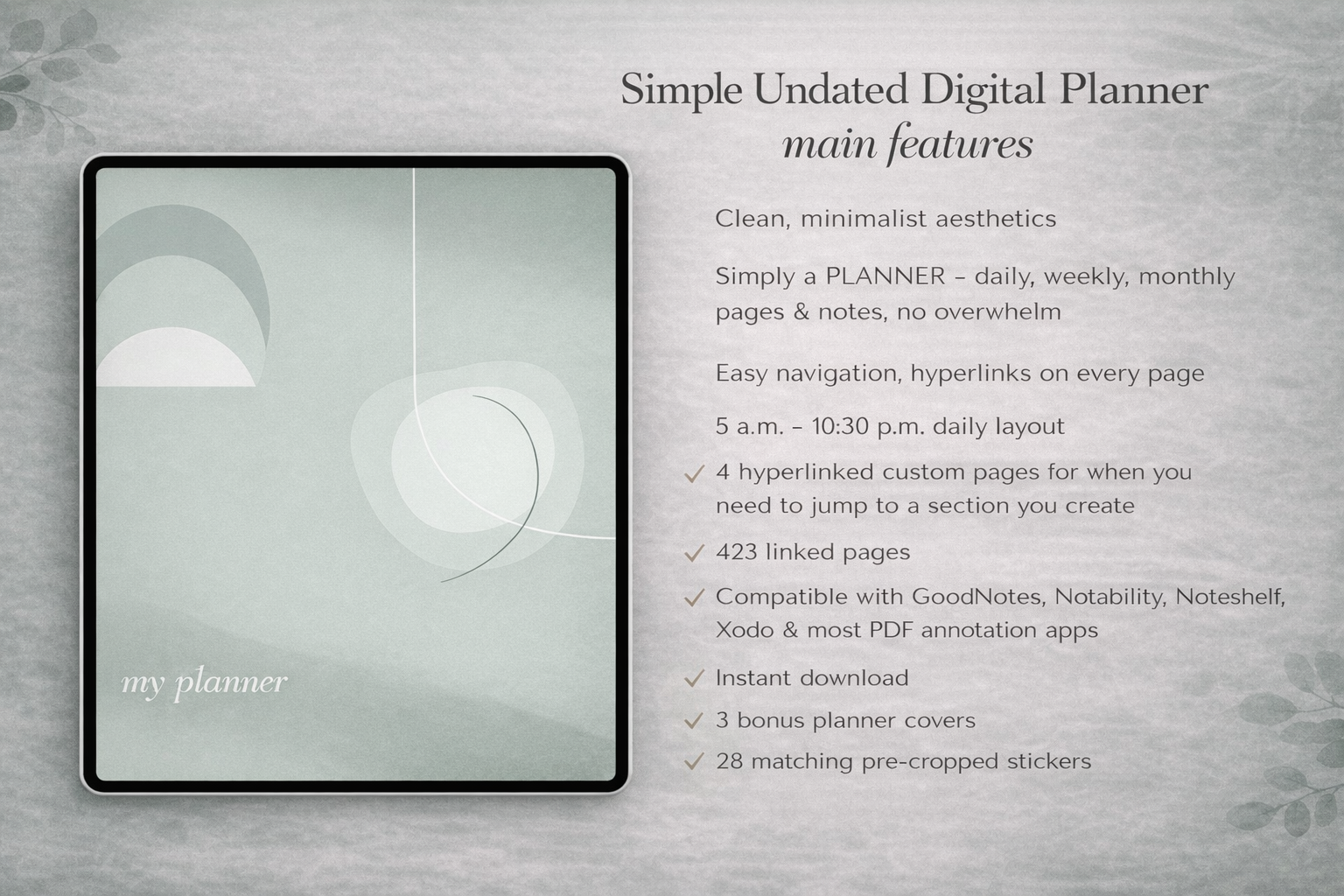
PlannerPier's Simple Undated Digital Planner includes both Monday-start and Sunday-start PDFs, so you can match the planner to your real weekly rhythm.
- check_circleBoth weekly start formats included in one calm planner bundle
- check_circleUseful for workweeks, family routines, and flexible planning styles
- check_circleLets buyers test fit without sacrificing the overall planner design
Who usually prefers Sunday-start planners
Sunday-start planners often feel better for users who think of the week as a full seven-day household or lifestyle cycle. Family planners, meal planners, and people whose weekend contains real work or preparation may prefer Sunday start because it brings the entire week into one continuous flow. Sunday becomes a visible launch point instead of an afterthought. For some users, that makes meal prep, routines, faith commitments, social plans, and family logistics easier to map naturally.
This layout can also work well if your weekly reset happens on Saturday or early Sunday. In that case, the page feels like it begins exactly where your planning energy begins. That emotional fit matters. People tend to stay with planners that feel obvious at a glance. If Sunday already feels like the real start of your week, a Monday-start layout can subtly create friction every time you orient yourself again.
The hidden factor is when your week really begins
Many people choose start day based on habit, but the better question is this: when does your planning week actually begin? If you use Sunday to reset, prep meals, review deadlines, and mentally launch Monday, then a Monday-start planner may still be right because Sunday is acting like setup time for the upcoming workweek. But if Sunday itself is full of meaningful planning, routines, care work, or events, you may benefit from seeing it as the first day on the page instead of the last.
This is why there is no universal best answer. A weekly layout should support your internal timing. Some people think in professional cycles. Others think in household cycles. Others in study cycles. The winning layout is the one that makes the week easier to read, not the one that matches someone else's preference. PlannerPier can lean into this idea because it is practical and immediately useful to shoppers who are stuck between two very similar product versions.
How this affects habit tracking and weekly review
Start day also changes the feel of habit tracking and reflection. In a Monday-start system, habits often read like part of the workweek rhythm, with the weekend acting as completion or reset space. In a Sunday-start system, habits may feel more lifestyle-oriented because the week begins with a full seven-day arc. Neither is better in principle, but each creates a slightly different emotional tone. One feels task-oriented. The other can feel more holistic.
Weekly review timing matters too. If you review on Friday or Sunday night, Monday start can feel satisfyingly clean. If your review happens during the weekend and flows directly into planning meals, family logistics, and routines, Sunday start may feel more natural. These are subtle but real differences. Over months of repeated use, small alignment often matters more than dramatic features. That is why this topic deserves more attention than most sellers give it.
How PlannerPier products already solve this well
One practical advantage PlannerPier already has is that products like the Simple Undated Digital Planner include both Monday-start and Sunday-start versions. That immediately lowers the risk of choosing wrong because the buyer does not have to sacrifice the overall planner style to test which weekly structure feels better. This is a strong product detail that deserves clearer SEO support because it answers a real purchase hesitation point.
It also fits the wider PlannerPier brand promise. The goal is decision removal. Offering both start formats inside a calm, usable planner is a clean example of that philosophy in action. Instead of forcing users to compromise or rebuild their weekly thinking around one format, the product meets them where they already are. That is a commercially strong message because it turns a small detail into a meaningful usability benefit.
How buyers can test the right layout quickly
The simplest test is to imagine your next real week, not an ideal one. Where do the busiest days sit? When do you plan meals, reset the household, or review work? When do you want the weekly spread to feel fresh? If you answer those questions honestly, your preference usually becomes clearer. You can also sketch one sample week in each format and see which one feels easier to scan. Very often, one layout simply feels more intuitive within a few minutes.
This kind of buyer guidance is valuable because it builds confidence before purchase. It is especially useful for people who have tried a planner before and quietly felt friction without knowing why. Sometimes the issue is not the planner category at all. It is the weekly reading pattern. By helping buyers test that quickly, PlannerPier can improve both conversion confidence and long-term satisfaction.
A simple recommendation framework
Choose Monday start if your week revolves around work, school, projects, or a strong weekday rhythm. Choose Sunday start if your week revolves around family flow, meal prep, care routines, or if Sunday already feels like the true beginning of the week. If you are still unsure, start with a planner that gives you both options so you can notice what feels better in actual use rather than guessing from theory.
This is the kind of practical decision support that makes PlannerPier content valuable. It helps the reader act, and it naturally leads into products that already solve the problem elegantly. That combination is exactly what strong SEO commerce content should do.
Frequently asked questions
Is Monday start or Sunday start better for digital planners?
Neither is universally better. Monday start often suits work or school routines, while Sunday start often suits household, family, or weekend-led routines.
How do I know which weekly layout fits me?
Look at when your week really begins in practice. If your reset happens before Monday and weekdays hold most of the action, Monday start is often better. If Sunday is an active planning day, Sunday start may fit more naturally.
Does PlannerPier offer both Monday-start and Sunday-start planners?
Yes. PlannerPier's Simple Undated Digital Planner includes both Monday-start and Sunday-start versions, which makes testing easier.
Pick the weekly layout that makes your planner feel instantly familiar
PlannerPier gives you flexible weekly planner options so your digital planning routine starts from the format that already makes sense to you. Explore more at https://www.plannerpier.com/.